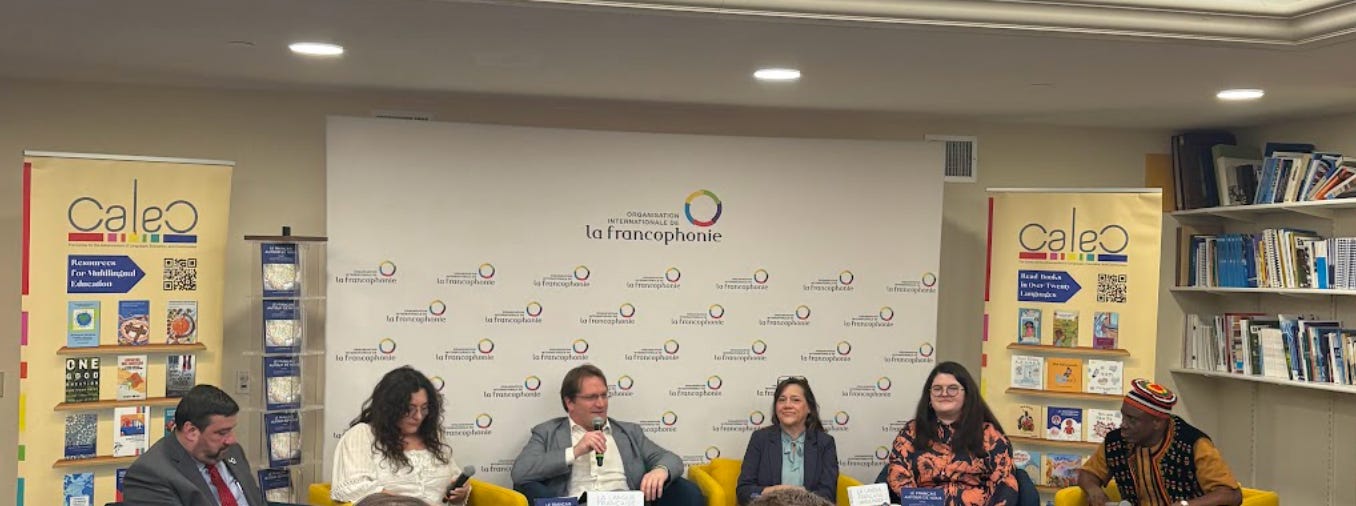
CALEC recently hosted French in Motion: Crossed Perspectives on Francophonie Today, a rich and timely conversation on the evolving place of French in the world and in the United States.
The event brought together scholars, educators, community leaders, and cultural advocates to explore the many ways French continues to move across borders, generations, communities, and identities. From global demographic shifts to local histories in Louisiana, New England, the Rust Belt, and bilingual schools, the discussion reminded us that French is not a fixed inheritance, but a living language shaped by those who speak it, teach it, reclaim it, and pass it on.
The full recording is now available here:
Change
One of the central themes of the conversation was change. The French language is constantly evolving, and so is the meaning of the word “Francophone.”
Being Francophone today cannot be reduced to citizenship, birthplace, or even perfect fluency. It may refer to people who speak French at home, students learning French in school, communities reclaiming a heritage language, immigrants maintaining multilingual identities, or families reconnecting with cultural roots across generations.
The conversation also highlighted how social media and digital platforms are changing how young people encounter the Francophone world. They now have access to voices, accents, cultures, and communities that were once less visible in traditional classrooms or cultural institutions.
Experience
The panel also explored the lived experience of speaking French outside dominant norms. Several speakers reflected on the pressures faced by communities whose French has sometimes been dismissed or undervalued, including Franco-American French, Québécois French, Louisiana French, Creole languages, and other regional or diasporic varieties.
This raised an important point: discrimination within a language community can be invisible to outsiders, but it has real consequences for speakers. Feelings of shame, hesitation, or linguistic insecurity can shape whether people choose to speak, teach, or transmit a language.
At the same time, the conversation showed that these communities are not simply preserving the past. They are actively redefining what French can be in American life.
Growth
A hopeful thread ran throughout the event: the Francophone world is becoming more diverse, more visible, and more open to multiple forms of belonging.
In the United States, recent French-speaking immigration has contributed to renewed interest in French-language communities and heritage. At the same time, many Francophone and French-speaking Americans already rooted in the country are rediscovering and reconnecting with their French-language histories, whether in New England, Louisiana, the Rust Belt, or other regions.
French as a heritage language is also gaining momentum, especially in places where family history, community memory, and education intersect. For young people, learning French can become more than the study of a foreign language. It can be a way to reconnect with family stories, regional identity, and a broader Francophone world.
Impact
The conversation also reminded us why language matters. Speaking and learning French can open doors to new perspectives, communities, professional opportunities, and ways of understanding the world.
But the impact of language goes beyond usefulness. Language carries memory, culture, values, relationships, and belonging. It allows communities to tell their own stories and imagine their futures.
French in Motion invited us to see Francophonie not as something frozen in time, but as something constantly being created — in classrooms, families, community centers, books, music, digital spaces, and public conversations.
We invite you to watch or revisit the full recording and continue the conversation with us.
Thank You
We extend our warmest thanks to our speakers and contributors: Son Excellence Michel Xavier Biang, Mohamed Embarki, Jessamine Irwin, Claire-Marie Brisson, Bertrand Tchoumi, Peggy Feehan, John Tousignant, Kathleen Stein-Smith, and Fabrice Jaumont.
Special thanks as well to the organizing and communications teams, and to our partners: the Organisation internationale de la Francophonie, CALEC – TBR Books, and French Morning.
Finally, thank you to everyone who joined the conversation, asked questions, shared reflections, and helped make French in Motion a meaningful exchange on the past, present, and future of Francophonie in the United States and around the world.