

farm-to-table: our freshest produce
Amidst the restless excitement of the city these past months, we at CALEC are also working tirelessly.
The world is shifting at a pace that is almost paralysing for one. There’s too much information to digest, too many skills to learn. How do we deliver the essence of all these important matters? That was the challenge that CALEC set for ourselves.
After many sleepless nights, we finally want to present our solutions: On September 1st, four new CALEC publications will officially be released!
These books are compacted with the essence of discussions and research relating to the hottest topics right now: artificial intelligence, education and identity.
Even better? All four books are now available for pre-order.
Beyond Perfection: The Beauty of Imperfect Language Learning — Volume 1
What does it mean to learn, inherit, and live with a language without speaking it “perfectly”?
Volume 1 explores heritage language learning, multilingual identity, family language transmission, and resistance across generations. Through the curation and compilation of multiple sources such as personal narratives and community-centered secondary research, this volume celebrates the complex — and often imperfect — ways languages remain part of our lives.
Beyond Perfection: The Beauty of Imperfect Language Learning — Volume 2
The conversation continues in Volume 2, further challenging assumptions about what successful language learning should look like. There is a key message that we want into bake into our pie: “imperfect” multilingualism is not a problem to be corrected. Instead, we should find ways to create a space for the diverse realities of multilingual speakers.
Bilingual Education in the Age of AI: Opportunities, Challenges, and New Directions
How can we embrace AI in education, specifically language education, without losing sight of the people and cultures rooted at its heart?
This timely collection brings together researchers, educators and school leaders to examine how artificial intelligence is reshaping bilingual and multilingual education.
Whilst we enthusiastically embrace the endless possibilities AI provides to us, we must not lose ourselves in the joy of its convenience. Instead, we must take a step back and ponder on the hidden side of the coin — issues surrounding bias, privacy, and educational equity.
Unlike a coin, we as civilisation do not exist in dichotomies. Thus, our CALEC contributors seek to explore the areas in between the “no-AI” and “yes-AI” camp. AI is a powerful but imperfect tool that we have developed, which must be used critically and responsibly. The future of bilingual education should be supported by these jewels of human creation, while remaining human-centered and language-conscious.
Global Citizenship Education: 30 Scenarios for Transformative K–12 Curriculum and Action
How can educators help students understand - and participate meaningfully in - an increasingly interconnected world?
Global Citizenship Education brings global issues into the educational conversation through 30 scenarios for transformative K–12 curriculum and action, offering another resource for educators seeking to connect classroom learning with the world beyond it.
Pre-order Global Citizenship Education
All four books will be released September 1. Pre-order your copies today and be among the first to read them.
cutting edge style (the man behind it all)
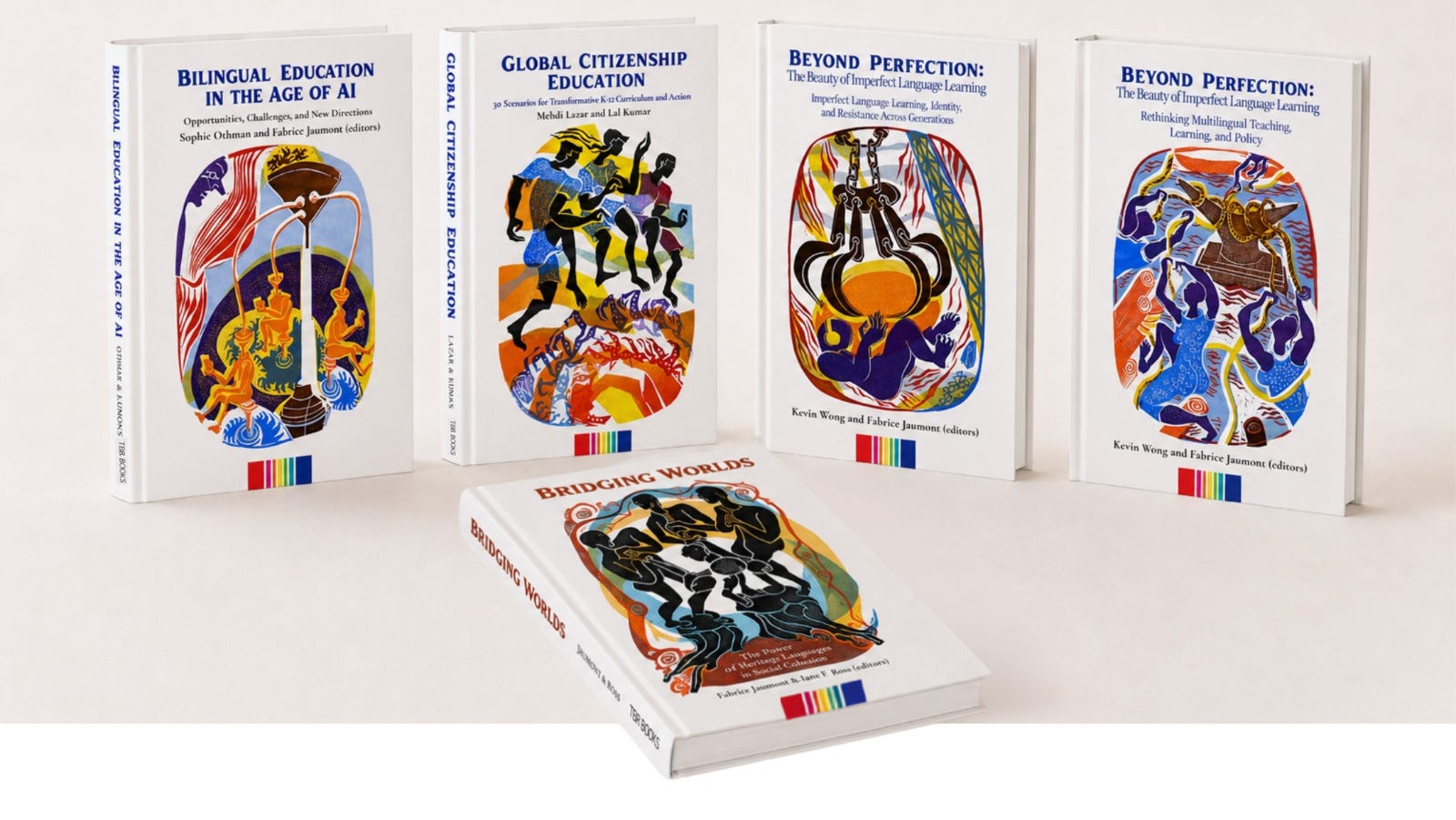
A book begins telling its story long before we turn the first page.
As we prepare to release four new titles, we also want to celebrate the visual language that brings them together — the mastermind behind it is a stranger to none.
Raymond Verdaguer’s work now spans five CALEC covers, including our previously featured Bridging Worlds and all four of our September releases.
Verdaguer’s brilliant mind bridges tradition and modernity together, using his trademark linocut technique to bring a bold and tactile illustration of CALEC’s literary worlds.
Linocut is a printmaking technique that transforms a simple sheet of linoleum into a work of art. The artist carves a design into the surface, applies ink to the areas left raised, and presses the block onto paper to reveal the final image.
Precisely because every line must be deliberately carved away or preserved, the process gives each composition a sense of intention and strikingness.
These physical prints then have to be scanned and uploaded to the digital world for us to turn them into usable covers.
Verdaguer has described his art as a means of building bridges between people and cultures. His philosophy and artworks truly reflect CALEC’s own identity and mission.
integrity in the shape of a platinum seal
We are proud to share that CALEC has earned the 2026 Platinum Seal of Transparency from Candid.
The Platinum Seal is Candid’s highest level of nonprofit transparency recognition.
Candid is one of the world’s leading nonprofit information platforms trusted by foundations and donors worldwide. It enables users to evaluate organizations before making funding decisions. Receiving the Platinum Seal affirms CALEC’s commitment to openness, measurable impact, and service to our communities.
Securing this achievement in our hands, we will continue to work tirelessly to contribute to the different communities that we serve.
This seal is more than just a recognition for us. It is our love letter to everyone who has been part of our CALEC journey and placed their faiths in our mission. We thank all who have been with us every step of the way. Your support means the world.
But wait. What does support really tangibly mean?
Many of you have been generously showing your love through monetary donations because of your faith in CALEC, allowing us (as a non-profit) to continue our operations.
We want to take the active step to show you where these funds go to. A donation isn’t simply a transaction. Every donation, large or small, will help support one of our 5 key areas:
E-learning
Supporting the smooth-running of our e-learning platform ‘Read in 2 Languages’, which contains digital multilingual resources and activities
Publishing
Contributing to costs of publishing and translating children’s books, as well as translating these books into a variety of languages
Educational Resources
CALEC has an ecosystem of initiatives supporting multilingual education and cultural understanding: TBR Books, New York in French, Révolution Bilingue Podcast, and Ri2L, which are facilitated by donation. Find out more about these on the initiatives section of our website
In-School Support
Your donation helps us implement CALEC’s initiatives - our books and e-platform - in classrooms, particularly in underserved communities in New York and Paris.
Community Initiatives
We organise book fairs, author talks, parent workshops, and educational conferences, all of which to promote multilingual education face-to-face.
Every individual’s effort is appreciated, and we want to ensure our subscribers can contribute in ways meaningful to them within reasonable capacity. Thus, we also want to provide a small illustration of what what your gift makes possible - no amount is too small to make an impact at CALEC.
$25 - Puts a bilingual storybook in a child’s hands. Gives one family access to Read in 2 Languages with a catalog of 200+ books in 20+ languages - this is perhaps the first time a child sees their home language and public language side by side.
$50 - Supplies one workshop session for families. Covers the materials — activity sheets, sample books, take-home guides — for a ‘raising a bilingual child’ workshop for families in our community.
$100 - Facilitates a workshop for a parent or teacher. Funds a facilitator’s time to run a hands-on session.
$120 - Gives one teacher a full year of Ri2L access. A classroom’s worth of multilingual lesson plans and activities, ready whenever the teacher needs them - for an entire school year.
$500 - Brings language learning to life, in person. Funds a full teacher training day, a parent workshop on raising a bilingual child, a multilingual book fair, or an author visit.
$1,000 - Translating a book into a new language. Covers the full cost of translating a book or other educational materials - meaning a family can read a popular story in their home language.
$2,000 - Translates and publishes a full educational resource. Funds translations and print-on-demand publishing process of a book or curriculum resource into a new language, opening it to an entire new community of readers.
There are many ways to be part of this work. Whether through sharing our work, joining our team, or donations through the channels listed on our website, every contribution helps turn support into educational access.
privilege, not yet a right
Across the United States, bilingualism is increasingly being recognized as an educational asset. However, a new report from the Migration Policy Institute (MPI) highlights an important gap between recognizing bilingualism and providing students with opportunities to develop it.
Dwindling bilingual opportunities
While bilingual and dual-language programs have expanded across the United States, access varies considerably by geography. MPI’s 2026 research draws particular attention to this phenomenon in secondary grades.
Among the challenges faced are shortages of qualified bilingual teachers, limited funding, and difficulties continuing programs as students transition from elementary into middle and high school.
State requirements also vary considerably. According to MPI, only five states—Connecticut, Illinois, New Jersey, New York, and Texas—require districts to establish bilingual programs when they reach specified thresholds of English Learners (ELs) who share a language background and grade level.
Bilingualism is a luxury. Why do we care when there are other pressing issues to worry about?
For native English speakers living in the US, bilingualism hardly sounds like a concern beyond boasting rights amidst friends. However, being supported in their journeys to master multiple languages is particularly significant for heritage language learners and ELs. For them, it means the ability to develop academic proficiency in English whilst maintaining a deep connection with their families and cultures.
As multilingualism gains greater recognition in American education, the conversation may therefore need to move beyond “Do we value bilingualism?” towards another question:
Are we giving youths a meaningful opportunity to become bilingual?
For CALEC, this distinction lies at the heart of our work. Celebrating and lauding multilingualism has its merits. Yet, we always strive to ensure that we are also creating the right type of educational resources that allow languages to be learned most valuably.
The report shines light on how the different methods of language education can meaningfully impact how ELs learn:
Bilingual education has been widely recognized as effective in supporting English Learners (ELs) by developing their language skills, affirming their cultural identities, and producing stronger long-term academic outcomes than English-only instructional models. A range of instructional models carry the name “bilingual education,” which describes their use of two languages (typically English and a partner language) to deliver academic content and instruction.
At CALEC, we recognise the need to balance different linguistic identities instead of picking one over the other. While texts written purely in the primary language of a learner could make its content easily understood, it would also reduce their effectiveness as learning tools.
That is why we have been pushing the boundaries of our creativity with bilingual books like Lapin is Hungry, seamlessly transitioning between languages as it crafts a beautiful narrative that anyone can follow.
Ending off on a hopeful note, whilst the report identifies the many gaps in the system, it also offers solutions to our challenges. Change is but one small action away.
Stay Connected
Follow CALEC for upcoming events, new publications, educational resources, and multilingual stories from around the world.
Instagram: @calecny
Facebook: CALEC.ORG
LinkedIn: CALEC
Thank you for being part of our multilingual community.